
Coating Oversight.
Verified Friction.
Independent oversight of helideck painting and anti-skid coating projects — from specification and hold-point inspection through to final CAP 437 wet friction testing, on steel and aluminium decks.
CERTIFIEDQuality Management System
2017International Consultancy
& IMPARTIALUnbiased & Objective
ASIA-PACIFIC & GLOBALNZ | Asia-Pacific | Africa | Americas | Australasia
SPECIALISTSSafety Is Our Priority
Helideck Coating Oversight & Painting Assurance
Independent, aviation-side assurance that a newly coated helideck will meet the friction performance it has to meet — verified while a defect is still cheap to correct.
A repaint you only get one chance at
A helideck repaint looks, on paper, like a straightforward marine coatings job. It is not. It is an aviation performance surface with a defined, measurable requirement, applied in an offshore environment, on a critical path that rarely has any float in it.
Audit Air Group perform helideck friction testing. In the course of that work we have tested newly applied coating systems — signed off, invoiced and handed back to the installation — that did not meet the minimum friction coefficients required by CAP 437. The coating was sound. The colour was right. The markings were crisp. The grip was not there.
At that point the client is in the worst possible commercial position. The deck is unserviceable. The contractor has demobilised. Remedial work means re-blasting, re-establishing containment, POB berths and deck closure — and on a producing asset or a vessel under charter, lost days that dwarf the original coating contract. There is no partial fix, and no negotiating with a friction number.
This service closes that gap: independent, aviation-side assurance that the deck you are paying for will pass the test it has to pass, verified at the point where a defect is still cheap to correct.
What CAP 437 requires
UK CAA CAP 437, Standards for Offshore Helicopter Landing Areas, is the reference document for offshore helideck surfaces and the basis on which most operators — and most flight crews — form a view of a deck’s serviceability. It is applied directly on the UK Continental Shelf and used internationally as the recognised benchmark, alongside ICAO Annex 14 Volume II, HSOG for ship-based decks, and client requirements drawn from the IOGP aviation reports.
The friction requirements are unambiguous:
| Location | Minimum average friction coefficient (µ) |
|---|---|
| Inside the touchdown/positioning marking circle — fixed installations | ≥ 0.60 |
| Inside the touchdown/positioning marking circle — moving installations (floating units, vessels) | ≥ 0.65 |
| Outside the touchdown/positioning marking circle — all installations | ≥ 0.50 |
Three points routinely catch coating projects out:
- Testing is performed wet. Dry results are not representative and are not accepted. A surface that feels well textured underfoot in the dry can still fall short.
- The whole deck is assessed, typically to a resolution of one square metre using a continuous-reading braked-wheel device. A single deficient zone is a deficient deck.
- Retest periodicity is earned by performance. The interval to the next test is tied to the result achieved. A deck that only just clears the threshold buys itself a shorter cycle and a recurring cost. A deck coated properly buys years.
That last point belongs in the coating specification. The objective is not to pass. The objective is to pass with margin.
Why new coatings fail the friction test
Failures are almost never caused by a defective product. They are caused by application decisions taken by people applying a marine coatings mindset to an aviation performance surface. The recurring causes we see:
- Anti-skid aggregate flooded by the topcoat. Texture applied correctly, then buried under a finish coat at too high a build. The deck looks excellent and tests poorly.
- Uneven or insufficient broadcast. Aggregate distributed by feel rather than by measured rate per square metre, producing bald zones invisible to the eye but not to the tester.
- Wrong aggregate grade. Too fine to generate macro-texture, or too friable to survive wheel loading and rotor downwash.
- Deck markings applied over the touchdown circle without texture. Marking paints are built for definition, not grip. Wide, smooth, high-build lines inside the TD/PM circle drag the average down.
- Application outside the environmental window. Substrate temperature within 3 °C of dew point, or humidity outside limits, gives adhesion failure that presents weeks later as aggregate pull-out under traffic.
- Testing or trafficking before full cure. A system tested before full cure can under-read — and a deck returned to service early can be mechanically damaged in its first week.
Each of these is detectable in real time by someone who knows what the friction test is going to measure. None is detectable after the scaffolding comes down.
Steel decks
Conventional steel plate helidecks carry a multi-coat system where the friction performance lives in one thin, easily compromised layer. Our oversight covers:
- Surface preparation — blast standard and cleanliness verified to ISO 8501-1, surface profile verified against specification using replica tape to ISO 8503, and soluble salt contamination checked by Bresle method (ISO 8502) before any primer is applied. Offshore steel that has spent a decade in salt spray is the single most common source of premature adhesion failure.
- Environmental control — substrate temperature, relative humidity and dew point recorded at each coat, against the product data sheet and project specification rather than the weather forecast.
- Coating system conformance — primer, intermediate and finish applied as specified, with batch traceability, recoat windows respected, and wet/dry film thickness measured and recorded to ISO 19840.
- Anti-skid application — aggregate grade, application method (broadcast into wet film or pre-blended) and coverage rate per square metre verified and witnessed, with sample panels retained.
- Topcoat and markings — controlled build over the anti-skid layer, and a markings scheme that does not create smooth zones inside the touchdown/positioning circle.
Where the asset works to NORSOK M-501 or a client’s own offshore coating standard, we work to that specification. We do not substitute our own.
Aluminium decks
Extruded aluminium plank decks — light, self-draining, and increasingly common on both fixed installations and vessels — are a different technical problem and a different commercial risk.
They behave differently under test. Profiled aluminium surfaces produce directional friction variation, and CAP 437 treats them as a distinct case. Legacy profiled decks may be assessed by conventional methods where they carry a suitable anti-slip finish; new profiled installations attract a one-time full-scale testing regime under controlled conditions using actual helicopter wheels at representative loads and orientations. The lowest measured value governs.
They are unforgiving to prepare. Aluminium cannot be treated as thin steel:
- Ferrous abrasive must not be used — embedded steel particles set up galvanic corrosion beneath the film. Preparation is by non-metallic sweep blast or controlled mechanical abrasion, preceded by proper degreasing.
- Primers must be suitable for the deck’s alloy; systems sensitive to alkaline conditions are a known failure mode.
- Thin plank sections respond to heat and thermal movement in a way plate does not, affecting both application and masking.
- Dissimilar-metal interfaces at the deck-to-structure connection need isolation maintained, not painted over.
And there is a trap specific to aluminium. Many plank decks are supplied with a manufacturer-applied friction surface, and the deck’s status may rest on that surface. Overcoating it — even with a good product, even to improve appearance — can invalidate the basis on which its friction performance was established and pull the deck into a full requalification exercise. We establish that position before a coating is specified, not after.
How we work
Audit Air Group act solely as the client’s technical representative. We do not paint decks, we do not supply coatings, and we hold no commercial position with the applicator. That independence is the service.
Before mobilisation
- Review of existing deck condition, friction test history and coating records
- Review of the proposed coating system against CAP 437 friction requirements and the asset’s coating standard
- Confirmation of recognised friction surface status on aluminium decks
- Preparation or review of the Inspection & Test Plan, with defined hold and witness points
- Review of the applicator’s procedures, equipment calibration and personnel qualifications
During application
- Verification and sign-off at each hold point — preparation, primer, intermediate, anti-skid broadcast, topcoat, markings
- Daily environmental and DFT records
- Non-conformances raised and closed while the crew and access are still on site
- Full photographic record
On completion
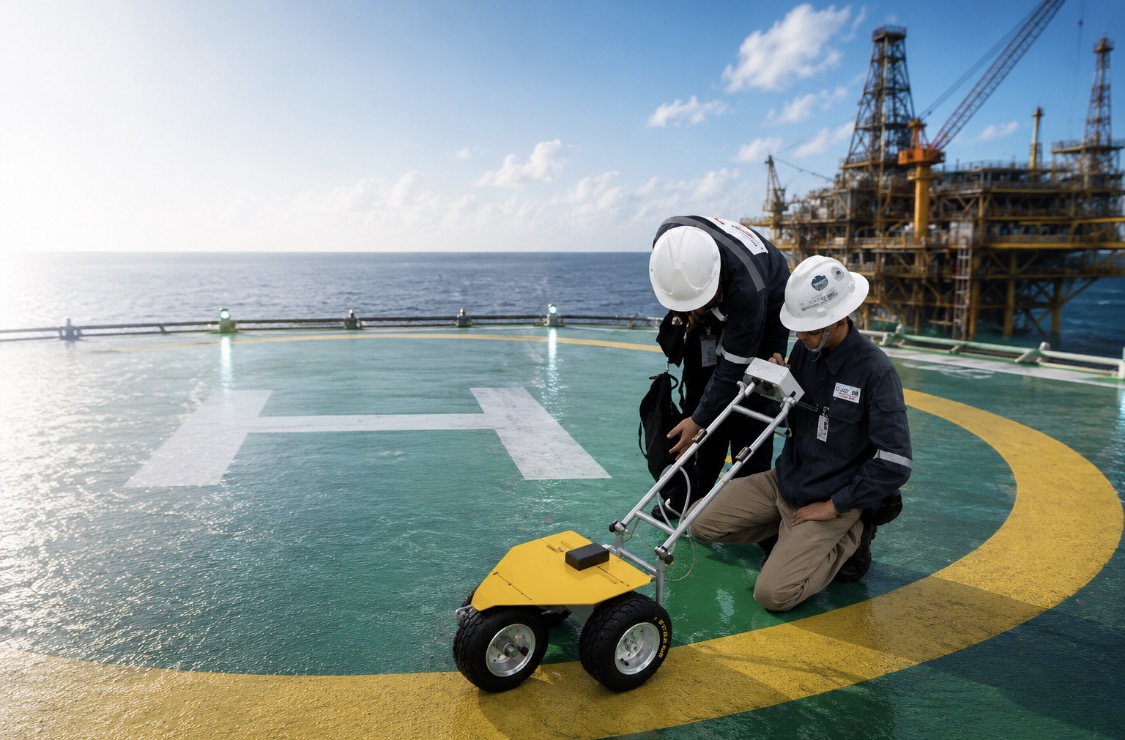
- Full-deck wet friction testing to CAP 437 once cure is confirmed
- Markings, perimeter safety net, drainage, lighting and obstacle environment checked against CAP 437 while access is available
- Certificate, friction survey plot and complete coating dossier issued for the client’s aviation and asset integrity records
If a defect appears, it appears on day two with the applicator standing next to it — not at handover with a helicopter inbound.
This service runs alongside our helideck inspections and standalone friction testing.
The commercial case
The cost of oversight is a fraction of the cost of a coating campaign, and a rounding error against the cost of doing it twice.
A failed friction test after handover means remobilising a contractor to a live asset, re-establishing containment and access, re-blasting a deck already stripped once, and closing the primary personnel transfer route for the duration. On a producing platform that is production impact, plus compromised medevac and crew-change capability. On a vessel it is off-hire. On a campaign with a weather window it is a season.
Clients ask for all-round assurance on the finished product because the process leaves no room for correction. That is precisely the assurance this service is built to deliver.
Painting a deck this campaign?
Bring us in at specification stage, not at handover. We will review the proposed system against CAP 437, define the hold points, and be on the deck when it matters.